Fairly mechanical. Did a few of the simple cases manually to make sure things were working, and I think the rest will be easily achievable via a quick `fastmod` command.

ref #1871
Yet another refactor to let us implement the many-to-many mapping
between codes and rules in a prefix-agnostic way.

We want to break up the RuleCodePrefix[1] enum into smaller enums.
To facilitate that this commit  introduces a new wrapping type around
RuleCodePrefix so that we can start breaking it apart.

[1]: Actually `RuleCodePrefix` is the previous name of the autogenerated
enum ... I renamed it in b19258a243 to
RuleSelector since `ALL` isn't a prefix. This commit now renames it back
but only because the new `RuleSelector` wrapper type, introduced in this
commit, will let us move the `ALL` variant from `RuleCodePrefix` to
`RuleSelector` in the next commit.
## Summary
The problem: given a (row, column) number (e.g., for a token in the AST), we need to be able to map it to a precise byte index in the source code. A while ago, we moved to `ropey` for this, since it was faster in practice (mostly, I think, because it's able to defer indexing). However, at some threshold of accesses, it becomes faster to index the string in advance, as we're doing here.
## Benchmark
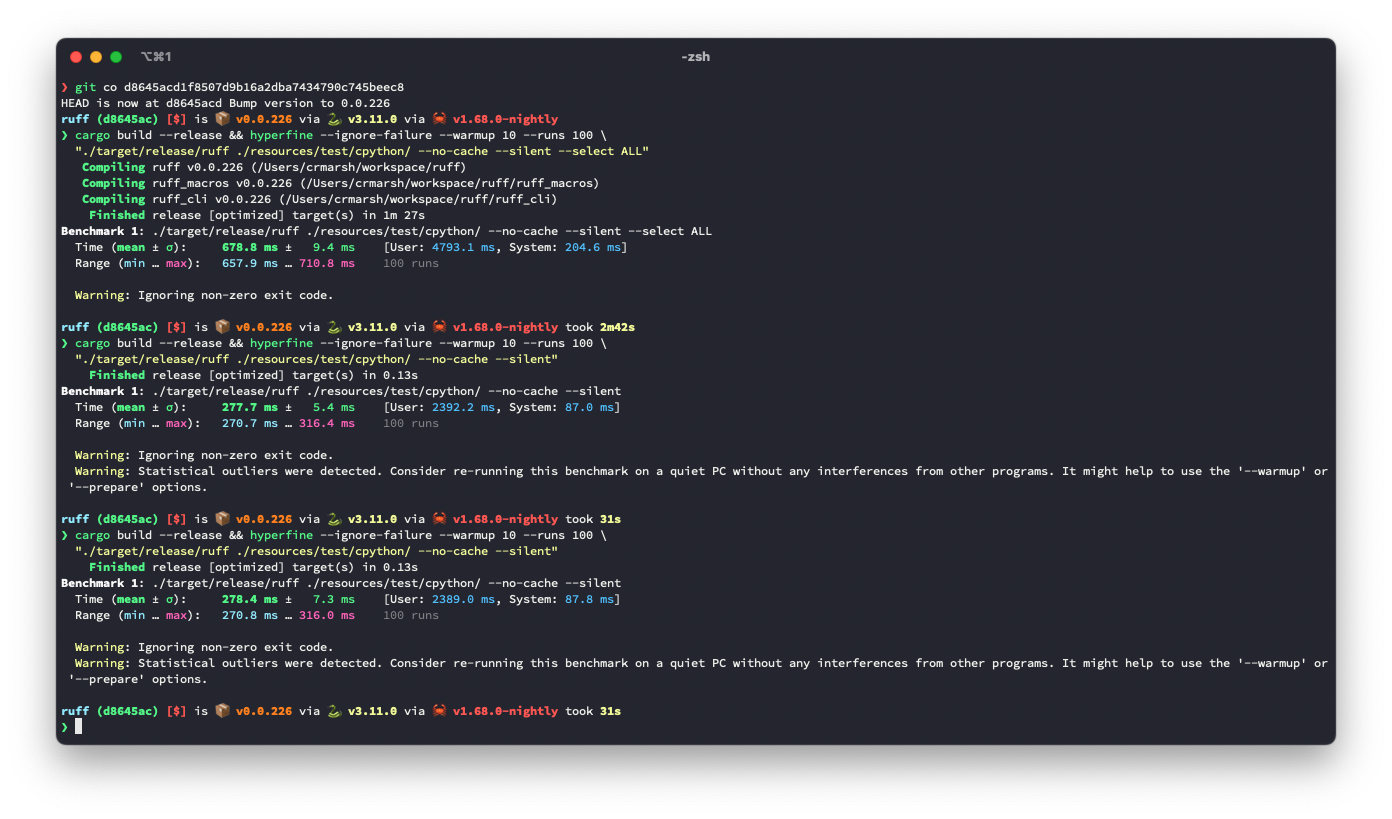
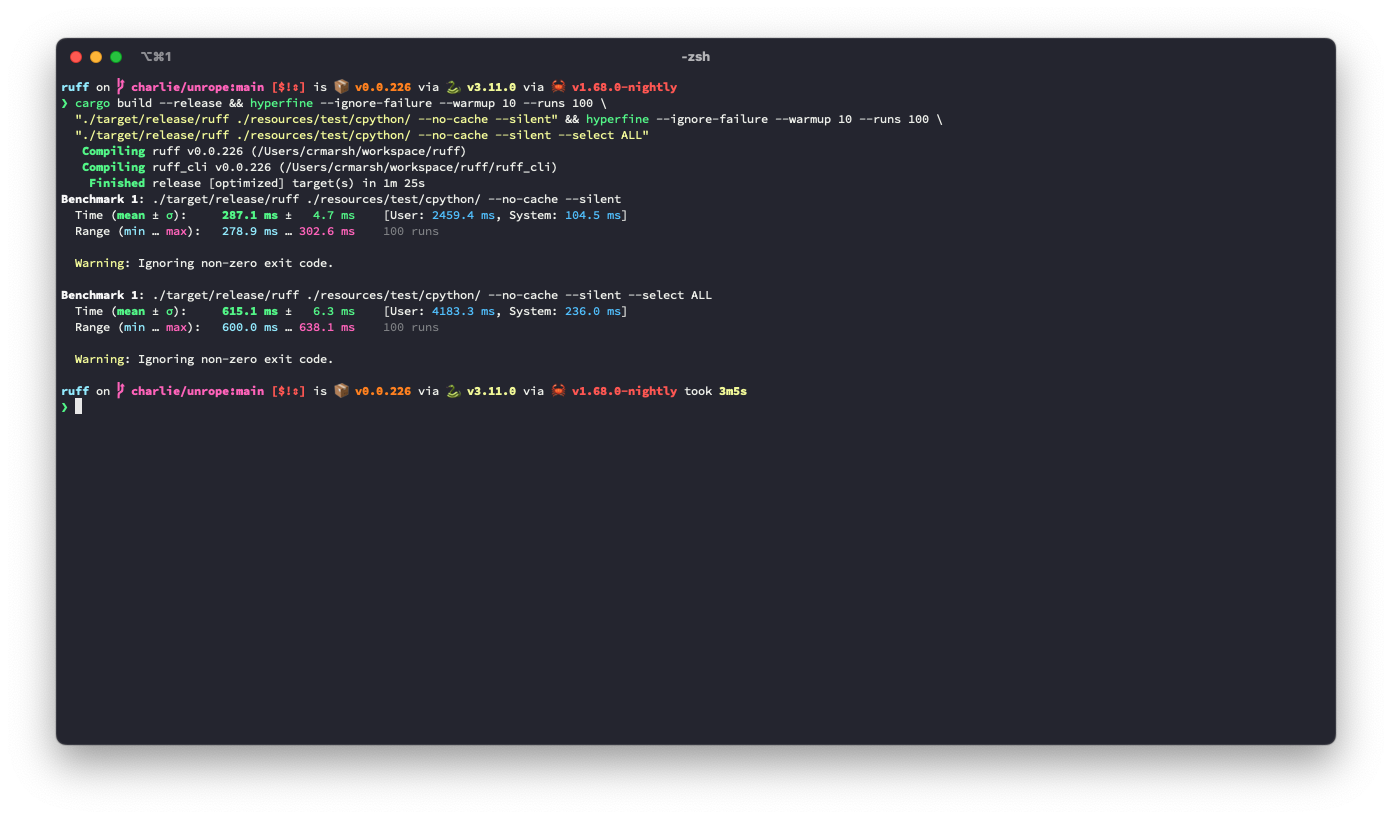
It looks like this is ~3.6% slower for the default rule set, but ~9.3% faster for `--select ALL`.
**I suspect there's a strategy that would be strictly faster in both cases**, based on deferring even more computation (right now, we lazily compute these offsets, but we do it for the entire file at once, even if we only need some slice at the top), or caching the `ropey` lookups in some way.
Before:
After:
## Alternatives
I tried tweaking the `Vec::with_capacity` hints, and even trying `Vec::with_capacity(str_indices::lines_crlf::count_breaks(contents))` to do a quick scan of the number of lines, but that turned out to be slower.
More accurate since the enum also encompasses:

* ALL (which isn't a prefix at all)

* fully-qualified rule codes (which aren't prefixes unless you say
  they're a prefix to the empty string but that's not intuitive)
# This commit was automatically generated by running the following
# script (followed by `cargo +nightly fmt`):

import glob
import re
from typing import NamedTuple

class Rule(NamedTuple):
    code: str
    name: str
    path: str

def rules() -> list[Rule]:
    """Returns all the rules defined in `src/registry.rs`."""
    file = open('src/registry.rs')

    rules = []

    while next(file) != 'ruff_macros::define_rule_mapping!(\n':
        continue

    while (line := next(file)) != ');\n':
        line = line.strip().rstrip(',')
        if line.startswith('//'):
            continue
        code, path = line.split(' => ')
        name = path.rsplit('::')[-1]
        rules.append(Rule(code, name, path))

    return rules

code2name = {r.code: r.name for r in rules()}

for pattern in ('src/**/*.rs', 'ruff_cli/**/*.rs', 'ruff_dev/**/*.rs', 'scripts/add_*.py'):
    for name in glob.glob(pattern, recursive=True):
        with open(name) as f:
            text = f.read()

        text = re.sub('Rule(?:Code)?::([A-Z]\w+)', lambda m: 'Rule::' + code2name[m.group(1)], text)
        text = re.sub(r'(?<!"<FilePattern>:<)RuleCode\b', 'Rule', text)
        text = re.sub('(use crate::registry::{.*, Rule), Rule(.*)', r'\1\2', text) # fix duplicate import

        with open(name, 'w') as f:
            f.write(text)
The Settings struct previously contained the fields:

     pub enabled: HashableHashSet<RuleCode>,
     pub fixable: HashableHashSet<RuleCode>,

This commit merges both fields into one by introducing a new
RuleTable type, wrapping HashableHashMap<RuleCode, bool>,
which has the following benefits:

1. It makes the invalid state that a rule is
   disabled but fixable unrepresentable.

2. It encapsulates the implementation details of the table.
   (It currently uses an FxHashMap but that may change.)

3. It results in more readable code.

       settings.rules.enabled(rule)
       settings.rules.should_fix(rule)

   is more readable than:

       settings.enabled.contains(rule)
       settings.fixable.contains(rule)
The caching mechanism of the CLI (ruff_cli::cache) relies on
ruff::settings::Settings implementing the Hash trait.

The ruff::settings::Settings struct previously couldn't automatically
derive the Hash implementation via the #[derive(Hash)] macro attribute
since some of its field types intentionally[1][2] don't implement Hash
(namely regex::Regex, globset::GlobMatcher and globset::GlobSet and
HashMap and HashSet from the standard library).

The code therefore previously implemented the Hash trait by hand for the
whole struct. Implementing Hash by hand for structs that are subject to
change is a bad idea since it's very easy to forget to update the Hash
implementation when adding a new field to the struct. And the Hash
implementation indeed was already incorrect by omitting several fields
from the hash.

This commit introduces wrapper types for Regex, GlobMatcher, GlobSet,
HashSet & HashMap that implement Hash so that we can still add
#[derive(Hash)] to the Settings struct, guaranteeing a correct hash
implementation.

[1]: https://github.com/rust-lang/regex/issues/364#issuecomment-301082076
[2]: The standard library doesn't impl<T: Hash + Ord> Hash for HashSet<T>
     presumably since sorted() requires an allocation and Hash
     implementations are generally expected to work without allocations.
The primary motivation is that we can now robustly detect `\` continuations due to the addition of `Tok::NonLogicalNewline`. This PR generalizes the approach we took to comments (track all lines that contain any comments), and applies it to continuations too.


